 >
>

Arriving at the dental office expecting a straightforward crown and leaving with a recommendation for a dental implant can feel surprising or even unsettling. Many of our patients in Woodland Hills, Calabasas, Tarzana, and across the San Fernando Valley share this experience.
This dramatic shift in treatment advice is rarely arbitrary. Instead, it reflects a careful clinical judgment about the long-term viability of your tooth’s foundation.
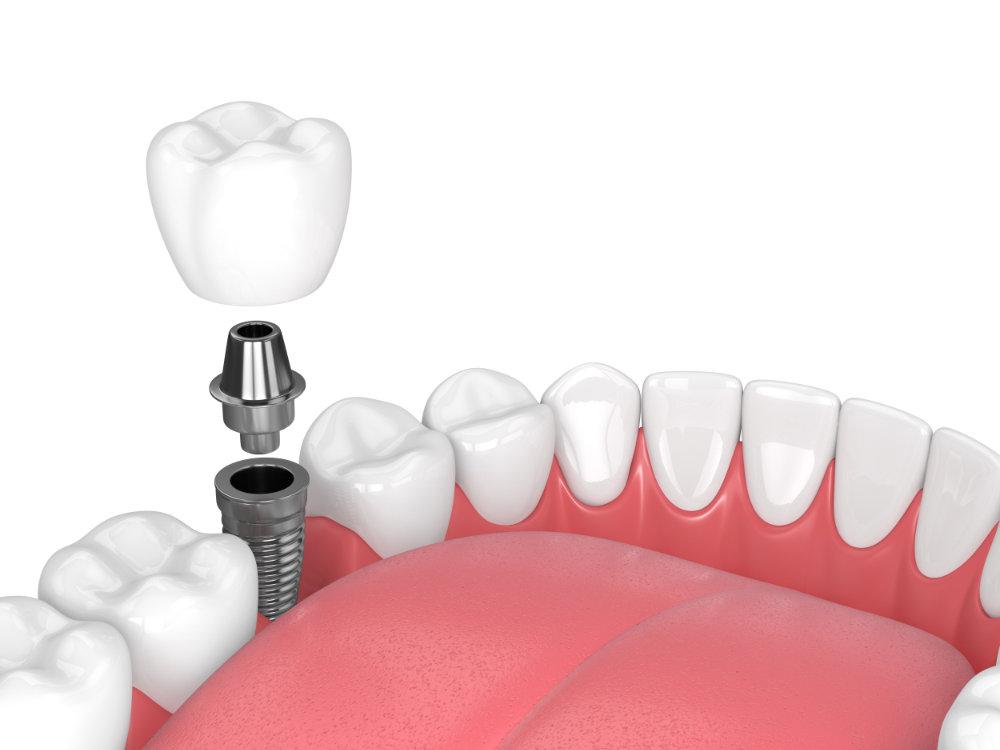
A dental crown preserves a living, healthy root by placing a custom porcelain or ceramic cap over a prepared natural tooth. A dental implant, by contrast, replaces an unsalvageable root structure entirely. It consists of a biocompatible titanium post that integrates with the jawbone, an abutment that connects the post to the restoration, and a custom crown that restores form and function.
When the underlying tooth root is compromised, placing a crown on that foundation often leads to recurrent problems, which is why your dentist is probably recommending the implant instead. Keep reading to learn more about crowns vs dental implants in Woodland Hills.
Structural Foundations: How Crowns vs. Implants Function
A dental crown functions like a protective helmet. The dentist removes decayed or damaged enamel and dentin, shapes the remaining tooth structure into a tapered preparation, and cements a custom-fabricated cap over it. The natural root and periodontal ligament continue to absorb and distribute chewing forces into the surrounding bone. For the crown to succeed long-term, enough healthy tooth structure must remain above the gumline to remain stable.
A dental implant operates differently with a three-part system. First, a titanium fixture is precisely placed into the jawbone, where it undergoes osseointegration, the biological process in which bone cells grow onto and fuse with the implant surface. Second, an abutment is attached to the implant once healing is complete. Third, a custom porcelain crown is secured to the abutment, restoring the visible tooth. Because the implant replaces the root itself, it does not rely on any remaining natural tooth structure.
Root health is the decisive factor between a crown or implant because a crown is only as strong as the root and surrounding bone that support it. When that foundation is fractured, extensively decayed below the gumline, or compromised by previous treatment failure, the crown cannot reliably transfer forces or seal out bacteria. In these cases, continuing with a crown risks further infection, bone loss, and eventual extraction.
Also Read: Unraveling the Science: How Do Dental Implants Stay in Place?
4 Clinical Reasons Your Dentist Prefers an Implant Over a Crown
Dentists commonly recommend implants over crowns when specific conditions make the natural root non-restorable. Four typical clinical scenarios drive this decision:
1. Vertical Root Fractures
Vertical root fractures extend from the crown portion of the tooth downward into or through the root. These cracks often remain hidden until they produce symptoms such as pain on biting, localized swelling, or a deep periodontal pocket. Because the fracture line communicates with the oral environment, bacteria continuously infiltrate the root canal space and surrounding bone. No amount of crown coverage can seal a fracture that travels below the gumline. Attempting to crown such a tooth typically results in persistent infection and eventual loss of the tooth. Extraction followed by implant placement removes the source of infection and provides a stable, long-term replacement.
2. Severe Subgingival Decay
Decay that extends significantly below the gumline destroys the natural tooth structure needed for crown retention. Even with advanced techniques such as crown lengthening, the remaining tooth may lack adequate height or quality of dentin. Placing a crown on insufficient structure creates an unstable restoration that is prone to leakage, recurrent decay, and fracture. When decay has compromised the root to this degree, removing the tooth and placing an implant eliminates the diseased tissue and restores function with a restoration that does not rely on compromised natural structure.
3. Failed Endodontic Therapy
Root canal treatment can successfully retain many teeth for decades. However, some teeth develop recurrent or persistent infections despite previous endodontic therapy. Causes include missed canals, complex anatomy, fractures, or bacterial leakage around existing restorations. When retreatment or surgical endodontics carries a guarded prognosis, or when the tooth has already undergone multiple interventions, the long-term outlook for crowning the tooth becomes poor. In these situations, extraction and implant placement often provide a more predictable outcome and spare the patient repeated procedures on a failing tooth.
4. Severe Structural Loss
Adequate natural tooth structure is required to achieve the ferrule effect essential for crown longevity. When trauma, extensive previous restorations, or aggressive decay have left little sound enamel and dentin, the remaining tooth cannot reliably support a crown. Posts and cores may temporarily reinforce the tooth, yet they do not compensate for the absence of a continuous band of healthy structure. Crowning a tooth in this condition frequently leads to root fracture or restoration failure within a few years. An implant avoids this cycle by replacing the entire root-crown complex with a durable, independent restoration.
Also Read: A Guide to Implant-Supported Bridges
Long-Term Oral Health for Bone Preservation and Neighboring Teeth
The decision between a crown and an implant extends beyond the individual tooth because it influences jawbone volume, adjacent teeth, and facial support over decades.
When a natural tooth is lost and not replaced with an implant, the alveolar bone that once surrounded the root begins to resorb. Without the stimulation provided by chewing forces transmitted through a root or implant, the body gradually reduces bone height and width in that area. Over time, this can lead to changes in facial contour, difficulty with future restorations, and shifting of neighboring teeth. A dental implant restores that functional stimulation. The titanium post transfers occlusal forces directly to the bone, helping maintain bone volume and density in a manner similar to a natural root.
Implants also protect adjacent teeth. Traditional fixed bridges require preparation (grinding) of the teeth on either side of the missing tooth so that a multi-unit restoration can be cemented. This irreversible alteration of healthy enamel and dentin increases the risk of future decay or need for root canal therapy on those abutment teeth. An implant stands independently. Neighboring teeth remain untouched, preserving their natural structure and long-term prognosis.
Longevity further distinguishes the two options. Dental implants demonstrate long-term success rates exceeding 95% in appropriate candidates and, with proper maintenance, can often function successfully for decades. Crowns on compromised roots, by contrast, may require replacement or lead to extraction within a shorter timeframe. Choosing an implant when the root is non-restorable therefore frequently proves more economical over a patient’s lifetime while delivering superior functional and aesthetic results.
What to Expect with Your Dental Implant Journey
The journey begins with comprehensive evaluation. Advanced 3D cone-beam computed tomography (CBCT) imaging provides detailed views of bone volume, density, nerve pathways, and sinus anatomy. Combined with clinical examination and discussion of medical history, this information allows the restorative team to determine whether an implant is feasible and what preparatory steps, if any, are needed.
If the compromised tooth remains, gentle extraction is performed. When bone volume is insufficient, a bone graft may be placed at the time of extraction or as a separate procedure to rebuild the site. Healing periods vary, typically ranging from a few months for simple cases to longer intervals when grafting is extensive.
Once the site is ready, the implant is placed with precision guided by the 3D planning. Local anesthesia ensures comfort during the procedure. In many cases patients report that the experience feels similar to or less involved than other common dental treatments. After placement, a healing phase of several months allows osseointegration to occur. Temporary restorations maintain aesthetics and function during this period when needed.
The final stage involves attaching the abutment and seating the custom porcelain crown. The restoration is designed to match the color, shape, and translucency of neighboring teeth, creating a seamless result. Follow-up visits confirm proper fit, occlusion, and hygiene access. With good home care and regular professional maintenance, the implant can serve reliably for many years.
Also Read: Dental Implants for Front Teeth vs. Back Teeth: What’s Different
Expert Dental Implants in Woodland Hills
Saving a natural tooth with a well-executed crown remains the preferred first option whenever the root and surrounding structures can support it. When deep fractures, extensive subgingival decay, failed endodontic therapy, or insufficient remaining tooth structure render the root non-restorable, a dental implant offers a more durable and biologically advantageous solution. Implants preserve bone, protect adjacent teeth, and deliver high long-term success rates.
Our experienced doctors at Woodland Hills Dental Care use advanced imaging and careful clinical evaluation to guide these decisions. Schedule a comprehensive restorative dentistry consultation at Woodland Hills Dental Care to determine whether preserving your tooth with a crown or replacing it with a dental implant is the most appropriate long-term solution.
FAQs
1. Why can’t my dentist just put a crown over my cracked or decayed tooth?
When a crack or decay extends below the gumline or significantly weakens the root, a crown cannot seal out bacteria or provide adequate retention. The underlying problem continues, often leading to infection, further fracture, or loss of the tooth. In these cases an implant addresses the compromised foundation rather than covering it.
2. Is getting a dental implant more painful or complex than getting a dental crown?
Modern dental implant surgery is typically performed under local anesthesia and is well tolerated by most patients. Many report that post-procedure discomfort is comparable to or less than that of other dental surgeries. While the overall timeline is longer because of the healing phase required for osseointegration, the clinical steps themselves are precise and controlled.
3. How much longer does a dental implant last compared to a traditional crown?
Dental implants frequently last decades and often a lifetime with proper maintenance, supported by success rates above 95 percent in appropriate candidates. Crowns on healthy roots can also last many years, but crowns placed on compromised roots tend to fail earlier, sometimes within five to ten years, necessitating further treatment.
4. Will my dental insurance cover an implant if a crown isn’t an option?
Coverage varies widely by plan. Some policies provide partial benefits for implants when they are deemed medically necessary after a tooth is non-restorable; others classify implants as elective. The team at Woodland Hills Dental Care can help review benefits and discuss financing options during the consultation.
5. How do I know if I have enough jawbone for a dental implant at Woodland Hills Dental Care?
Three-dimensional CBCT imaging allows precise measurement of bone height, width, and density. When bone volume is insufficient, grafting procedures can often rebuild the site successfully. Professional evaluation at Woodland Hills Dental Care will determine the most appropriate sequence of care for each patient.
Disclaimer: This article is for educational purposes and is not a substitute for professional advice from a dentist or oral surgeon. Always consult with your dentist before making decisions that can impact your dental health.